
The Missing App in the Small Business Stack: Legal AI
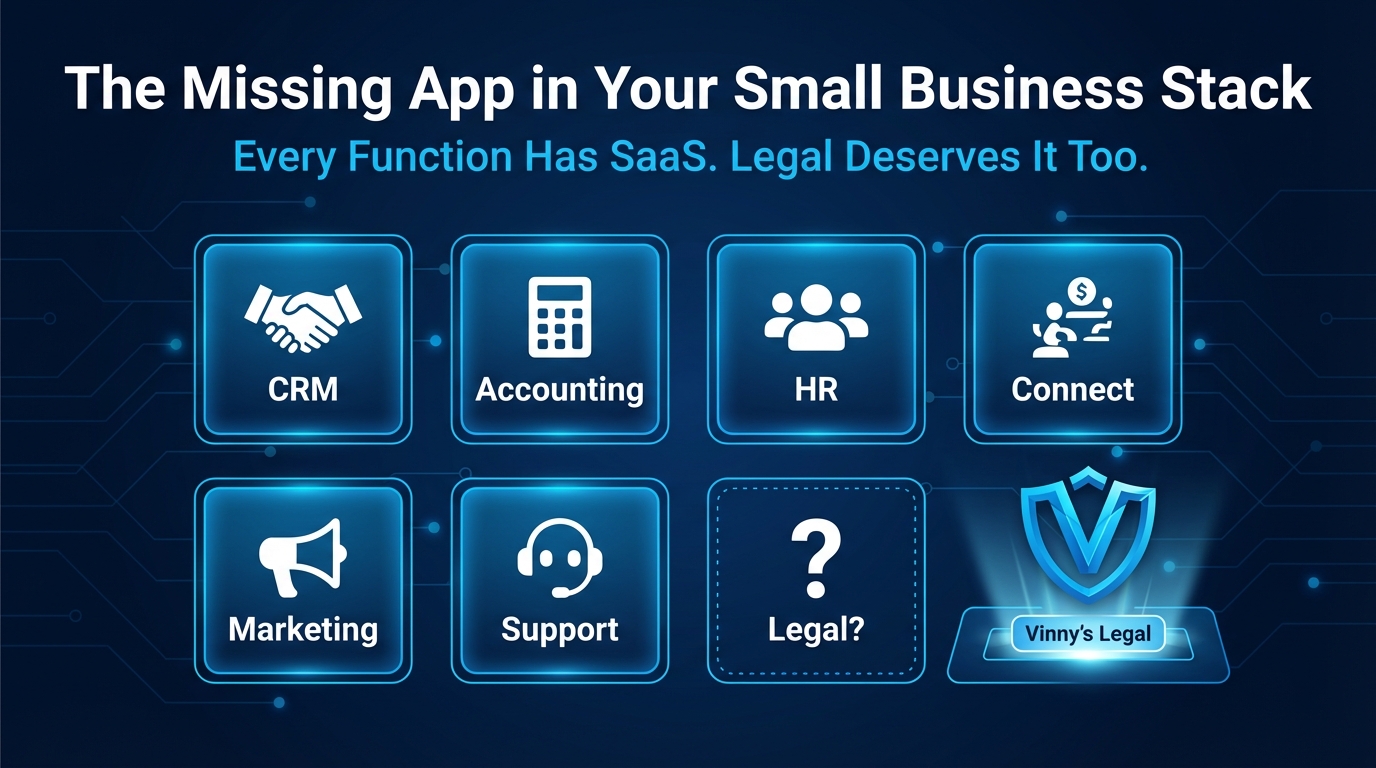
If you've been running a small business for more than five minutes, you've probably noticed something funny about your software stack.
On the one hand, it's incredibly sophisticated. You've got:
- A polished CRM to track prospects and customers
- An accounting system that cranks out invoices and reconciles bank feeds
- HR running on some payroll/benefits platform
- Customer support with its own ticketing system
- A modern CMS for your website
- Social media managed through scheduling and analytics tools
- Project management boards for everything
In other words, you're running the kind of tech stack that only big enterprises could dream about fifteen years ago.
But then there's legal.
The Gap in Your Stack
Ask most small businesses, "What do you use for legal?" and the answers are... very different.
Usually it's some combination of:
- "We have some templates a lawyer gave us a few years ago."
- "We grabbed an NDA or terms-of-use template from the internet."
- "We use an e-signature tool for contracts."
- "We call our lawyer when something feels scary and try not to think about the bill."
It's a stark contrast.
Sales, finance, HR, marketing, and support all have proper SaaS platforms. Legal is still a mix of Word files, PDFs, and anxiety.
And that gap has been treated as normal. Until now.

Try Vinny, the legal AI platform designed to complete your business stack
Upload your document and get plain-English summaries, risk highlights, and actionable checklists in minutes.
How Every Other Function Got a SaaS Platform (Except Legal)
Look at how the rest of the business evolved:
Sales
Before: Spreadsheets and handwritten notes
Now: Even the smallest teams spin up a CRM on day one because it's unthinkable to track deals in a notebook
Accounting
Before: Paper receipts and an overworked bookkeeper
Now: You plug in bank feeds, sync invoices, and your accountant logs into a shared system
HR
Before: A folder in a filing cabinet
Now: You invite a new hire by email and they onboard through an HR platform without touching paper
Support
Before: Shared inboxes
Now: Structured ticketing systems
Marketing
Before: "Post when you remember"
Now: Dashboards, campaigns, and scheduled content
In each of these areas, software didn't just digitize what you were doing, it made it easier for non-experts to do a good job.
Legal never had that moment.
Templates and E-Signatures: Useful, But Not a Legal System
For small businesses, "software for legal" has basically meant two things: templates and electronic signatures.
Helpful? Yes. Transformative? Not really.
What Templates and E-Sign Tools Actually Solve
Templates give you a starting point:
- If you have no NDA at all, having a basic NDA template is better than nothing
- Same with employment offers, privacy policies, or SaaS agreements
But those templates:
- ❌ Aren't tailored to your risk tolerance or business model
- ❌ Go stale as laws and industry practices change
- ❌ Drift into "version chaos" when sales edits them, then ops edits them, and no one knows which one is "real" anymore
Then you add an e-signature tool:
- ✅ You can get contracts signed faster
- ✅ Track who signed what
- ✅ Keep a tidy signed copy
What You Still Don't Have
The hard part: Whether what you're signing is actually good for your business.
- Is that indemnity clause normal or dangerous?
- Does this DPA actually match what you're doing with data?
- Is that "standard" limitation of liability going to come back to haunt you?
- Did someone quietly change your IP ownership language in the redline?
Templates and e-signatures are like having a blank form and a really nice pen.
You can write and sign something very quickly. But neither of them tells you what you should write or whether you should sign.
That's the hole in the stack.
Why That Gap Matters More Now
If business were as simple as "I build something, you pay me," maybe this wouldn't be a huge problem.
But the reality most small businesses live in today is structurally more complex:
- ✅ You're signing customer MSAs that run to 20+ pages
- ✅ You're subject to privacy rules if you touch consumer data
- ✅ You're hiring across multiple states or countries
- ✅ You're using and providing software that moves data across borders
The contracts you're signing and the policies you publish aren't just formalities anymore.
They're part of your:
- Sales motion
- Brand
- Compliance posture
- Relationships with customers and employees
And yet, for most small businesses, the legal "system" is still:
- A bunch of Word documents on a shared drive
- A handful of templates that may or may not be current
- A vague fear that somewhere, there's a clause that isn't in your favor, but you're not sure where
It's not that anyone wants it this way. It's just that, unlike CRM or accounting, there hasn't been a true "legal platform" designed for businesses that don't have an in-house legal team.
That's the gap Vinny is designed to fill.
See how Vinny completes your business stack with legal AI
Upload your document and get plain-English summaries, risk highlights, and actionable checklists in minutes.
Vinny: Legal AI for Business
The simple idea behind Vinny is this:
If every core function of a small business now runs on specialized SaaS, legal should too.
Not in the sense of "another place to store PDFs," but as a tool that actually helps you:
✅ Understand what's in your contracts and policies
✅ Draft and refine them in a way that fits your business reality
✅ Spot risk before it becomes a problem
✅ Empower non-lawyers on your team to handle day-to-day questions without guessing
Legal AI for Business Means You Can:
Talk to a system in normal language about the things you deal with all the time:
- "Can you review this customer's MSA and tell me what's risky for us as a small SaaS vendor?"
- "We're hiring our first person in California, what should we think about in the offer letter?"
- "We want to run a giveaway on Instagram for US customers only; can you draft some simple terms?"
- "Compare our current vendor contract to this renewal proposal and tell me what changed."
Where before you had two options:
- Ignore the issue
- Email your lawyer and hope it's not too expensive
Now there's a third: You ask Vinny first.
How This Fits Alongside the Tools You Already Use
The interesting thing is that Vinny doesn't replace any of your existing stack.
It doesn't send invoices. It doesn't manage tickets. It doesn't post on social media.
What it does is sit next to all of that and help you align the legal side with reality:
Your CRM (Sales)
You're closing a deal and living inside your CRM, Vinny helps you understand and negotiate the contract that actually governs the relationship.
Your Finance System
Your finance team is thinking about renewals, termination rights, and automatic price increases, Vinny helps decode those clauses across all those vendor agreements.
Your HR Platform
HR is sending out offers and handbooks, Vinny helps make sure the language matches the commitments you're comfortable making and the jurisdictions where people sit.
Your Marketing Tools
Marketing wants to try something new like a contest, referral program, or data-driven campaign, Vinny helps translate the rules into practical, "here's how to do this safely" guidance.
In other words, Vinny doesn't live in a silo like "the legal tool over there."
It's closer to a legal layer that runs through your existing stack.
Not a Replacement for Lawyers, But a Real System for Everything in Between
It's worth stressing one point: Vinny is not about replacing human lawyers, especially where legal judgment is needed.
If you're selling your company, restructuring ownership, facing a regulatory investigation, or dealing with a serious employment dispute, you absolutely want a human attorney in the room.
Where Vinny Shines
In the 60,80% of legal work that small businesses either:
- Don't do at all ("We'll deal with that later")
- Do quickly and nervously ("Just sign it, they're a big customer")
- Do in a way that's expensive and slow ("We have to send this minor thing to outside counsel again")
That's the space where other departments got their SaaS tools years ago.
Sales doesn't call a revenue consultant every time they add a lead. Marketing doesn't call an agency every time they want to post a tweet. They have systems.
Legal has been the exception.
With Legal AI for Business, that doesn't have to be true anymore.
The Bottom Line: Legal Finally Joins the Stack
If you zoom out for a second, what's happening here is pretty simple:
✅ Small businesses already run on a sophisticated ecosystem of SaaS tools
✅ Every major function has dedicated technology to make non-experts effective
✅ Legal has lagged behind, stuck at the level of templates and signatures
✅ The complexity of contracts, data, and regulation has grown, not shrunk
Vinny exists because that combination no longer makes sense.
Legal deserves the same kind of thoughtful, purpose-built software layer the rest of your business already enjoys.
Not:
- A pile of boilerplate
- Just a faster way to sign things
But:
A real, conversational, always-on legal teammate that understands business context and helps you act with more confidence.
That's Legal AI for Business. That's the role Vinny is meant to play in your stack.
Ready to Get Started?
Join professionals who are using Vinny to handle legal questions faster and more confidently. Free trial available.
Not a law firm • Not legal advice • AI-Powered Assistance
Disclaimer
This content is for informational purposes only and does not constitute legal advice. Vinny AI is not a law firm and does not provide legal services. For specific legal questions, please consult with a licensed attorney.
See how Vinny can help
Upload your document and get plain-English summaries, risk highlights, and actionable checklists in minutes.